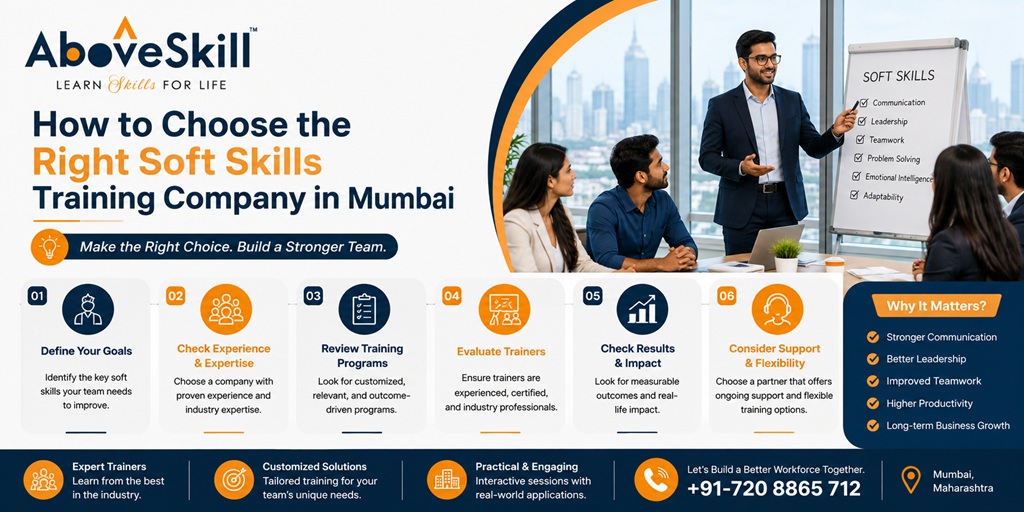
How to Choose the Right Soft Skills Training Company in Mumbai
Choosing the right soft skills training company in Mumbai comes down to four things — trainer background, how customised the program actually is, whether the format (online, offline, or hybrid) fits your team, and whether the cost matches the depth of program you need. Skip anyone who can’t clearly explain how they’d design a session for your specific team before quoting a price.
We’ve sat on both sides of this conversation — designing programs, and occasionally getting pitched by other vendors trying to sell us referral partnerships. So when people ask us how to actually evaluate a soft skills training company in Mumbai, we’re not guessing. Here’s what we’d tell a friend doing this for the first time.
What Should You Look for in a Soft Skills Training Company?
Look for a company that asks about your team before pitching a solution — that’s the single biggest signal of quality. A trainer who launches straight into a brochure of modules without asking what’s actually going wrong in your team is selling a template, not a program.
Beyond that, check three things directly: trainer background (have they actually worked in a corporate environment, or only trained one?), industry experience (has the company handled your sector before — BFSI, manufacturing, IT & ITES?), and what happens after the session ends. A one-off workshop with no follow-up rarely changes behaviour on its own.
How Much Does Soft Skills Training Cost in Mumbai?
Soft skills training pricing in Mumbai varies enormously — a standard half-day workshop can run into the low thousands per participant, while a premium, fully customised program with an experienced facilitator can climb into tens of thousands per day.
According to a corporate training pricing analysis published by KnowledgeHut, standard sessions in India often start around ₹1,000 per participant, while specialised, expert-led, or experiential programs can range from roughly ₹30,000 to over ₹1.5 lakh per day depending on trainer seniority, group size, and depth of customisation. Group size matters too — smaller, more personalised groups tend to cost more per head, since there’s less room to standardise delivery. The honest answer is: ask for a quote based on your actual group size and objectives, and be suspicious of anyone quoting a flat number before knowing either.
Is Soft Skills Training Actually Worth the Investment?
Yes, when it’s tied to a specific business problem — fewer escalations, smoother handoffs, managers who give feedback instead of avoiding it — rather than treated as a generic annual HR requirement.
It’s genuinely harder to measure than a sales training program with a revenue number attached. But the cost of not training tends to show up anyway, just less visibly: repeated miscommunication, attrition tied to poor management, conflicts that drag on because nobody has the skill to resolve them early. If you’re weighing whether it’s worth it, the better question is whether the specific problem you’re trying to solve is big enough to justify the specific program you’re considering — not whether “soft skills training” in the abstract is worth it
Should You Choose Online, Offline, or Customised Soft Skills Training?
Offline (on-site) training tends to work better for role-plays, simulations, and team dynamics exercises, because in-person energy is hard to replicate over video. Online training works well for content-heavy modules, distributed teams, or when scheduling an in-person session across multiple offices isn’t realistic.
Customisation matters more than the online/offline decision itself. A generic online module delivered to a disengaged room does less for your team than a well-designed on-site session — and a poorly-run virtual workshop can undo the value of good content entirely. If your team spans Mumbai, Thane, and Navi Mumbai, ask any shortlisted provider specifically how they keep hybrid sessions interactive, since that’s where most virtual programs quietly fail.
Which Trainer Is Best for Corporate Employees?
The best trainer for corporate employees is one who’s actually managed people, handled client pressure, or led a project — not just someone certified to deliver a curriculum. Certification (ISO 9001:2015, CPD UK accreditation, or similar) signals a baseline of quality control, but it doesn’t replace real workplace experience.
Ask for a sample session outline specific to your team, not a generic one. A strong trainer adjusts tone and examples for a room of client-facing sales executives differently than for a back-office finance team — if they can’t explain how they’d do that, they’re probably running the same deck regardless of audience.
Comparing Trainer Types by Fit
Trainer Background | Strength | Watch For |
Ex-corporate professional turned trainer | Real workplace credibility, practical examples | May need support structuring formal curriculum |
Career soft skills trainer (certified) | Strong delivery technique, structured modules | Can lean generic without a genuine needs assessment |
Freelance/independent trainer | Flexible, often lower cost for small groups | Quality varies widely — check references directly |
In-house L&D-linked training firm | Deep customisation, ongoing relationship | Usually a higher minimum commitment |
How to Evaluate a Provider Before You Sign — A Quick Checklist
- Ask what problem they’d solve first. A good provider probes before pitching; keep asking why.
- Request a sample outline for your team, not a generic brochure.
- Check industry-specific experience relevant to your sector.
- Clarify the format — on-site, virtual, or hybrid — and how they keep it engaging.
- Ask what follow-up looks like after the session ends.
- Get a quote tied to your group size and goals, not a flat rate card.
- Ask for references you can call, not just testimonials on a website.
Once you’ve narrowed your shortlist, our types of soft skills training programs we offer page breaks down each specific area — communication, leadership, emotional intelligence, and more — if you want to match a provider’s offering against what your team actually needs.
Frequently Asked Questions
How do I know if a soft skills training company in Mumbai is legitimate?
Check for verifiable accreditation like ISO certification or recognised Train-the-Trainer credentials, ask for references you can actually call, and look for named case studies from real industries rather than vague testimonials. A legitimate provider will happily connect you with a past client.
What’s a reasonable price range for a one-day soft skills workshop in Mumbai?
Prices vary widely by trainer seniority and group size, but standard sessions often start in the low thousands per participant, with specialised or experiential programs running considerably higher. Always request a quote based on your specific group size and objectives rather than comparing generic price lists.
Is it better to choose a company or an individual freelance trainer?
It depends on your need — a company typically offers more structure, follow-up support, and bench strength for larger rollouts, while a skilled freelance trainer can be a cost-effective, flexible option for smaller teams or one-off workshops. Check references either way.
Can soft skills training be customised for a specific industry like BFSI or manufacturing?
Yes, and it should be — a provider with genuine industry experience will ask about your sector’s specific pressures before designing content, rather than reusing a generic module. Ask directly whether they’ve delivered training in your industry before.
How soon can a soft skills training company start a program after we sign?
Timelines vary, but most providers need at least a needs-assessment call before finalising content, so build in a few days to a couple of weeks depending on program complexity. Rushed programs without a proper needs assessment tend to be more generic.
Do soft skills training companies in Mumbai offer trial or sample sessions?
Many do, especially for larger engagements — it’s a reasonable thing to ask for before committing to a multi-session program. If a provider refuses to offer any preview of their approach, treat that as a caution sign, not just a policy.
Before You Sign Anything
Don’t start by comparing prices — start by writing down the actual problem you’re trying to solve in one sentence. Then ask each shortlisted provider how their program addresses that specific sentence. The ones who can answer clearly, without falling back on a generic pitch, are the ones worth a longer conversation.