POSH Training & Compliance Service Providers in Pune
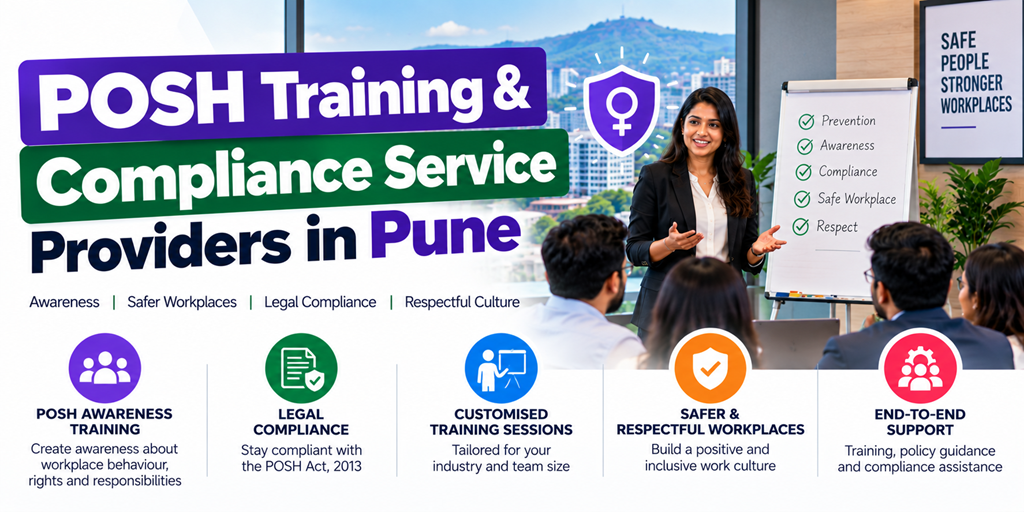
POSH training service providers in Pune deliver two connected services: employee-wide awareness training on the Sexual Harassment of Women at Workplace (Prevention, Prohibition and Redressal) Act, 2013, and specialised training for Internal Committee (IC) members who handle actual complaints. Any company with 10 or more employees is legally required to have a functioning IC, and Pune’s fast-growing IT and startup scene means a lot of companies cross that threshold faster than their compliance setup catches up.
That gap is more common in Pune than people expect. A company scales from 8 employees to 40 within a year, HR is focused on hiring and onboarding, and nobody formally sits down to constitute an Internal Committee until an audit, a client compliance check, or a complaint forces the issue. If that sounds familiar, this page covers what the training and compliance side actually involves, and what to check before hiring someone to run it.
What Do POSH Training Service Providers in Pune Actually Offer?
POSH training service providers in Pune typically cover two distinct audiences in one engagement: general employee awareness sessions (what counts as harassment, how to report it, what protections exist) and separate, deeper training for Internal Committee members who investigate complaints.
These shouldn’t be the same session stretched across two audiences. Employees need to understand their rights and how to raise a concern. IC members need to know how to conduct a fair inquiry, maintain confidentiality, apply natural justice principles, and issue a recommendation that would hold up if challenged. A provider running identical content for both groups is usually under-serving the IC.
What Should You Look for in Corporate POSH Compliance Trainers in Pune?
Corporate POSH compliance trainers in Pune should be able to speak specifically to how Pune’s IT, ITES, and startup-heavy business environment affects compliance setup, since many companies here scale fast and can cross the mandatory-IC threshold before anyone notices.
Ask a trainer directly how they handle a company that’s never formally constituted an IC despite having crossed 10 employees months or years ago. If they treat this as a routine, fixable gap rather than something alarming, that’s usually a good sign, since it is a common and correctable situation, not a crisis.
Who Can Serve as an External Member for a POSH Committee in Pune?
An external member for a POSH committee in Pune is legally required for any company with 10 or more employees, since the Sexual Harassment of Women at Workplace (Prevention, Prohibition and Redressal) Act, 2013 mandates that every Internal Committee include at least one external member, typically someone from an NGO or associated with women’s rights issues.
This isn’t a formality to tick off and forget. An external member brings genuine independence to the IC’s proceedings, someone without internal reporting lines or office politics shaping how a complaint gets handled. Companies sometimes appoint someone to this seat who’s never actually attended a hearing. That’s worth checking directly if your IC has been sitting unused for a while.
What Happens in a POSH Awareness Workshop for Employees in Pune?
A POSH awareness workshop for employees in Pune usually runs half a day and covers what constitutes sexual harassment under the law, how to file a complaint, what confidentiality protections exist for the complainant, and what happens procedurally once a complaint is raised.
Good sessions use scenario-based discussion rather than reading the Act aloud. A workshop that just recites legal definitions tends to produce compliance on paper, employees who technically attended, but limited actual understanding of how to use the process if they ever need to.
What Does POSH Internal Committee Training in Pune Actually Cover?
POSH Internal Committee training in Pune focuses on the practical mechanics of running an inquiry: how to receive a complaint, maintain the timelines mandated by the Act, conduct interviews fairly, weigh evidence, and draft a recommendation that follows due process.
This is the training most companies underinvest in, because forming an IC and appointing members can feel like the finish line. It isn’t. An IC that’s never been trained on how to actually run a hearing is likely to make procedural mistakes the first time a real complaint comes in, exactly when the stakes are highest. IC members should be retrained periodically, not just once when the committee is first formed.
Comparing POSH Service Types
Service | Audience | Typical Frequency |
Employee awareness workshop | All employees | Annually, or for new joiners |
IC member training | Internal Committee members only | At IC formation, then periodic refreshers |
External committee member placement | Ongoing IC role | Ongoing, reviewed periodically |
POSH policy and setup review | HR/Legal | At IC formation, or whenever law changes |
How to Set Up POSH Compliance for a Growing Pune Company: A Step-by-Step Process
- Confirm your obligation. If you have 10 or more employees, even just crossed that number recently, you legally need a functioning Internal Committee.
- Form or review your IC. Check that it includes a senior woman employee as Presiding Officer and at least one qualified external member.
- Draft or review the policy. Confirm it reflects current law and your actual company practice, not a generic template.
- Train the IC. Cover inquiry procedure, timelines, and confidentiality requirements specifically for the people who’ll handle complaints.
- Train all employees. Run an awareness session covering rights, reporting channels, and what to expect if a complaint is raised.
- Repeat periodically. Refresh both IC and employee training on a regular cycle, not just once at formation.
For a broader look at how AboveSkill approaches workplace training generally, our corporate training company in Mumbai page covers our full process across all program types.
Frequently Asked Questions
Are POSH training service providers in Pune required for all companies?
Any company with 10 or more employees is required under the Sexual Harassment of Women at Workplace (Prevention, Prohibition and Redressal) Act, 2013 to form an Internal Committee, and periodic training for both the IC and employees is part of fulfilling that obligation properly. Skipping training doesn’t remove the legal requirement to have a functioning IC.
What is the difference between employee POSH training and IC training?
Employee training covers awareness, rights, and how to report a concern, while IC training goes deeper into inquiry procedure, timelines, and how to handle a complaint fairly once it’s raised. Companies in fast-growing sectors like Pune’s IT industry often train employees but skip proper IC training, leaving the committee unprepared when a real complaint comes in.
Who qualifies as an external member for a POSH committee in Pune?
The Act requires the external member to be someone associated with women’s rights issues or affiliated with an NGO working in that space, not just any outside professional. This person should also be trained on the IC’s procedures, not simply appointed and left out of ongoing preparation.
Our company grew quickly and we’re not sure if we ever formally set up an Internal Committee. What should we do?
This is a common situation, especially among fast-scaling companies, and it’s correctable. The first step is a compliance review to confirm your current employee count against the legal threshold, then forming or reconstituting the IC properly with the required external member.
How often should POSH training be repeated in Pune?
Employee awareness sessions are typically run annually or for new joiners, while IC members should receive periodic refresher training beyond their initial onboarding to the committee. A policy or training that hasn’t been revisited in several years is a common compliance gap worth checking.
Can POSH training be delivered on-site for our Pune office?
Yes, most providers offer on-site delivery for both employee awareness sessions and IC-specific training, alongside virtual options for distributed teams. On-site tends to work better for IC training specifically, since it involves more sensitive, interactive discussion.
Time to Check Where Your Compliance Actually Stands
Before booking a training session, it’s worth asking a blunter question first: does your company actually have a properly constituted Internal Committee, or did growth outpace that setup somewhere along the way? If you’re not sure, that uncertainty is the real starting point, and we’re happy to walk through what a proper review and training cycle would look like for your company.