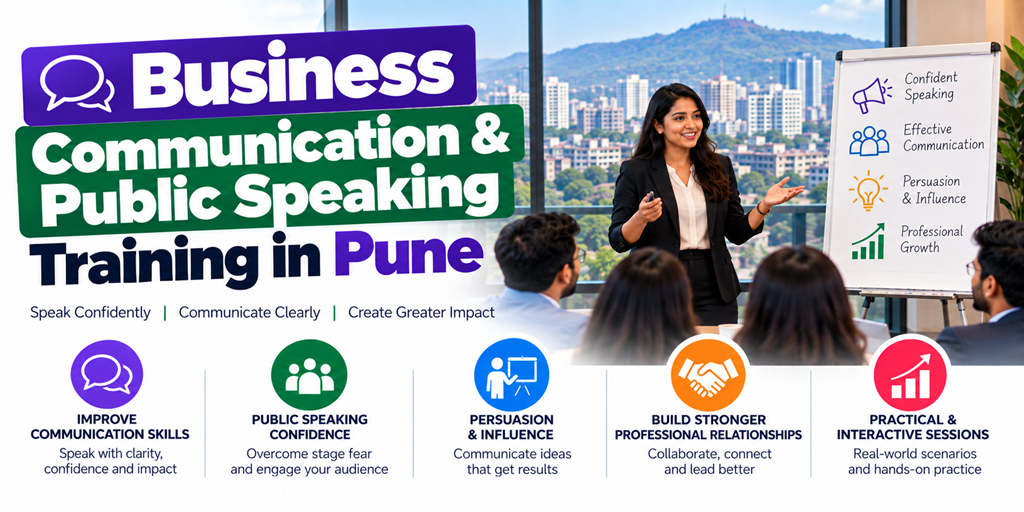
Business Communication & Public Speaking Training in Pune
A business communication skills trainer in Pune typically covers verbal communication, public speaking, and written communication like email etiquette, with a particular focus on client-facing and cross-cultural scenarios given Pune’s large IT and services workforce. The best programs address written and verbal communication together, since a team can be confident speakers and still write emails that land wrong with an international client.
I’ve sat in on more than a few Pune training sessions where the verbal communication piece goes great, people loosen up, practice gets genuinely better, and then the written communication conversation reveals a completely different gap. Someone writes a perfectly clear internal status update that reads as curt or even rude to a client in a different country who doesn’t share the same shorthand. That’s not a confidence problem. It’s a specific, teachable skill gap, and it’s one most generic communication training skips entirely.
What Does a Business Communication Skills Trainer in Pune Actually Teach?
A business communication skills trainer in Pune typically teaches verbal communication (meetings, presentations, client calls), written communication (emails, documentation, reports), and non-verbal communication (body language, tone, presence), adapted to how your specific team actually communicates day to day.
The “adapted” part matters more than people expect. A sales team’s communication gaps look different from an engineering team’s, and a trainer who runs the exact same generic module for both is missing something. Ask a prospective trainer how they’d adjust content for a technical team versus a client-facing one, if they don’t have a clear answer, they’re probably running one standard deck regardless of audience.
What Happens in a Public Speaking Workshop for Corporates in Pune?
A public speaking workshop for corporates in Pune usually covers structuring a talk, managing nervousness, using body language effectively, and handling Q&A under pressure, practiced through actual presentations rather than theory alone.
The real test of a good public speaking workshop isn’t whether people feel more confident in the room. It’s whether that confidence survives the first real presentation back at the office, in front of an actual client or leadership team, a few weeks later. Programs that include a follow-up presentation or check-in tend to produce results that actually stick, versus a one-off session that fades once the adrenaline wears off.
What Does Email Etiquette Training for Employees in Pune Cover?
Email etiquette training for employees in Pune covers tone, structure, clarity, and cross-cultural nuance, particularly relevant given how much of Pune’s workforce, especially in IT and ITES roles, communicates in writing with international clients and colleagues across different cultural norms.
NASSCOM’s data on India’s IT and ITES workforce has repeatedly highlighted Pune as one of the country’s largest hubs for client-facing technical work, much of it conducted over email and written channels rather than in person. A message that reads as efficient and direct internally can land as abrupt or even dismissive to a client in a culture that expects more conversational framing. That gap costs more client goodwill than most companies realize, and it’s rarely addressed in generic email-writing tips about subject lines and signatures.
What Is Covered in Professional Communication Skills Training in Pune?
Professional communication skills training in Pune typically ties together verbal presence, written clarity, and situational judgment, knowing when a quick message is appropriate versus when a conversation is actually needed, rather than treating communication as a single uniform skill.
That situational piece gets overlooked constantly. A team that’s great at presentations can still default to long email threads for decisions that would’ve been resolved in a two-minute call, or vice versa, jump straight to a meeting for something a short message could’ve handled. Teaching people to read that situation accurately is often more valuable than polishing any single communication format further.
How Do You Know Which Communication Gap Your Team Actually Has?
Your team needs public speaking training if people avoid presenting, freeze under pressure, or struggle to structure a talk clearly. Your team needs email etiquette training if written messages are causing friction with clients or colleagues, especially across cultures. Your team needs broader professional communication skills training if the issue is more about judgment, knowing which channel and tone fits a given situation, than any single skill.
Most companies book whichever training sounds most familiar, usually public speaking, without actually diagnosing where the friction really is. A team with excellent presenters can still lose client trust over a string of poorly-worded emails. Figuring out which gap is actually costing you something matters more than defaulting to the most obvious training format.
Comparing Communication Training Types
Training Type | Best For | Typical Format |
Public speaking workshop | Teams uncomfortable presenting or pitching | Practice presentations, recorded feedback sessions |
Email etiquette training | Teams writing frequently to international clients | Writing exercises, tone and structure review |
Professional communication skills | Teams needing broader situational judgment | Mixed verbal and written practice, scenario-based |
Combined program | Most corporate teams | Multi-session, covering all three areas |
How to Choose the Right Communication Training for Your Team: A Step-by-Step Process
- Identify where the actual friction is. Client complaints about tone, presentation anxiety, or unclear written communication point to different training.
- Review real examples if possible. A few actual emails or a recorded presentation tell you more than a general impression.
- Match the training type to the specific gap. Don’t default to public speaking just because it’s the most commonly requested format.
- Check for cross-cultural relevance. Especially important if your team communicates regularly with international clients.
- Build in follow-up practice. A single session rarely changes communication habits permanently without reinforcement afterward.
For a broader look at how AboveSkill designs soft skills training across formats, our corporate soft skills workshop page covers our full process.
Frequently Asked Questions
What does a business communication skills trainer in Pune typically cover?
Most cover verbal communication, public speaking, and written communication like email etiquette, adapted to how your specific team actually communicates. The right mix depends on where your team’s real communication friction shows up.
Is a public speaking workshop for corporates useful for employees who rarely present?
Yes, since most employees eventually need to present something, a status update, a project pitch, a client update, even if it’s not a frequent part of their role. Building this skill early tends to reduce avoidance and anxiety when a bigger presentation opportunity comes up.
Why does email etiquette training matter for teams that already write professionally?
Because professional and effective aren’t always the same thing, especially across cultures. A message that reads as clear and efficient internally can land as abrupt to an international client with different communication norms, which is a common gap in Pune’s client-facing IT and services teams.
What’s the difference between professional communication skills training and public speaking training?
Public speaking focuses specifically on presenting to groups, while professional communication skills training covers broader situational judgment, knowing which channel and tone fits a given moment, alongside both verbal and written skill-building.
Can communication training be customized for teams that work mostly with international clients?
Yes, and it should be. A good provider builds in cross-cultural communication nuance specifically, since norms around directness, tone, and written formality vary significantly between regions and can cause real friction if left unaddressed.
How long does a typical business communication training program run?
Programs range from a single half-day workshop focused on one specific skill to multi-session programs covering public speaking, written communication, and situational judgment together over several weeks.
Ready to Find Where Your Team’s Real Communication Gap Is?
Tell us honestly where the friction actually shows up, nervous presenters, emails that land wrong with clients, or just general unclear communication, and we’ll recommend training built around that specific gap instead of a generic communication skills module.