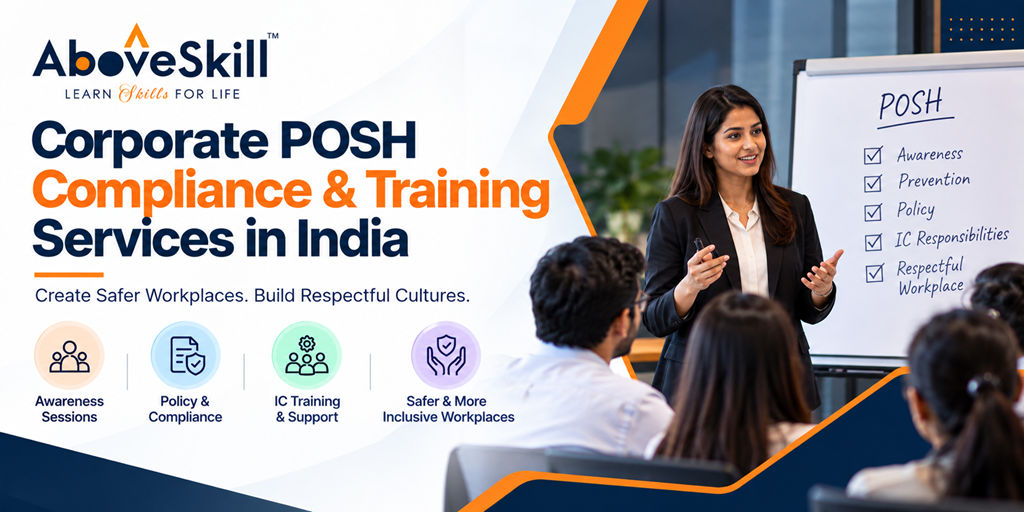
Corporate POSH Compliance & Training Services in India
POSH training providers in India deliver three connected services: employee awareness training under the Sexual Harassment of Women at Workplace (Prevention, Prohibition and Redressal) Act, 2013, specialised training for Internal Committee (IC) members, and compliance audits that check whether an existing IC and policy actually meet legal requirements. Any Indian company with 10 or more employees at a given location needs a functioning IC there, not just at head office.
That last point trips up more companies than you’d expect. A business with offices in three or four cities often assumes one Internal Committee, usually based wherever HR sits, covers the whole organization. It doesn’t work that way under the law. Each location that crosses the 10-employee threshold needs its own properly constituted IC. If your company operates in multiple cities, that’s worth checking before anything else on this page.
What Do POSH Training Providers in India Actually Offer?
POSH training providers in India typically offer three distinct services: general employee awareness sessions, specialised Internal Committee member training, and compliance audits that review whether an existing setup actually satisfies the Act’s requirements.
These aren’t interchangeable. An awareness session teaches employees their rights and how to raise a concern. IC training teaches committee members how to run a fair, legally sound inquiry. A compliance audit checks whether the paperwork, committee composition, and policy actually hold up, often the step companies skip until an external audit or a real complaint forces the question.
What Does Corporate POSH Training for Employees Usually Cover?
Corporate POSH training for employees usually covers what constitutes sexual harassment under the law, how to file a complaint, what confidentiality protections exist, and what happens procedurally once a complaint is raised, delivered through scenario-based discussion rather than a straight reading of the Act.
A session that just recites legal definitions tends to produce compliance on paper, employees who technically attended, but limited real understanding of how to actually use the process if they ever need it. The better sessions walk through realistic workplace scenarios and let employees ask questions they might otherwise feel awkward raising.
Why Does POSH Compliance Training for Companies Matter Beyond the Legal Requirement?
POSH compliance training for companies matters beyond ticking a legal box because an untrained workforce and an untrained Internal Committee both increase the chance that a real complaint gets handled badly, which creates legal exposure far larger than the cost of proper training.
A company that’s never trained its IC is essentially hoping a complaint never arrives. When one does, an untrained committee is more likely to make procedural mistakes, miss statutory timelines, or mishandle confidentiality, any of which can turn a manageable situation into a legal and reputational problem.
How Do You Hire a POSH Trainer for a Corporate Workshop?
To hire a POSH trainer for a corporate workshop, start by confirming the trainer’s actual experience running both employee awareness sessions and IC-specific training, since these require different depth, then ask for references from companies of a similar size and industry to yours.
Ask directly how they’d structure a workshop for your specific employee count and location setup. A trainer who gives a generic answer regardless of whether you have 15 employees in one office or 300 across five cities probably runs the same program for everyone, which isn’t ideal given how differently PoSH compliance plays out at different scales.
What Makes a Certified POSH Training Agency in India Worth Choosing?
A certified POSH training agency in India worth choosing should be able to clearly explain the statutory requirements they’re training against, the 10-employee IC threshold, the external member requirement, and the inquiry timelines, rather than offering a generic “workplace respect” seminar that doesn’t actually address compliance obligations.
Ask any agency you’re evaluating to walk you through exactly what the Act requires, not just what their workshop covers. If they can’t clearly separate “what the law requires” from “what our program includes,” that’s a sign the training may not actually get you to compliance, even if it’s well delivered.
Who Can Serve as a POSH External Committee Member for Hire?
A POSH external committee member for hire must be someone associated with women’s rights issues or affiliated with an NGO working in that space, as required by the Act, placed on your Internal Committee to bring independence to its proceedings.
This person needs more than just the right background on paper. They should actually understand IC procedure and be available to participate in real hearings, not appointed once and left out of ongoing committee activity. Companies sometimes treat this seat as a formality, which defeats the purpose of having an independent voice on the committee in the first place.
What Happens During a POSH Compliance Audit?
A POSH compliance audit reviews your existing Internal Committee composition, your policy document, and your past handling of any complaints against what the Act actually requires, flagging gaps like a missing external member, an outdated policy, or a committee that was never properly constituted at a growing office location.
This step matters most for companies that have been operating for a while without a formal review, or that have grown and opened new offices without updating their compliance setup to match. A compliance audit before training usually makes more sense than training against a policy or committee structure that has gaps nobody’s checked.
Comparing POSH Service Types
|
Service |
Audience |
Typical Trigger |
|
Employee awareness training |
All employees |
Annually, or for new joiners |
|
IC member training |
Internal Committee members only |
At IC formation, then periodic refreshers |
|
External committee member placement |
Ongoing IC role |
Ongoing, reviewed periodically |
|
POSH compliance audit |
HR/Legal |
Before training, after growth, or ahead of a client/regulatory audit |
How to Set Up POSH Compliance for a Company Operating Across India: A Step-by-Step Process
- Map every location against the employee threshold. Any office with 10 or more employees needs its own functioning IC.
- Audit existing committees and policy. Check composition, the external member, and whether the policy reflects current law.
- Fill any gaps in committee formation. Constitute or reconstitute an IC wherever one is missing or improperly formed.
- Train the IC. Cover inquiry procedure, statutory timelines, and confidentiality requirements for the people who’ll actually handle complaints.
- Train all employees. Run awareness sessions covering rights, reporting channels, and what to expect if a complaint is raised.
- Repeat on a regular cycle. Refresh both IC and employee training periodically, not just once at formation.
For a closer look at how this works city by city, our PoSH compliance and IC training page covers our Mumbai delivery in more detail.
Frequently Asked Questions
Are POSH training providers in India required for every company?
Any company with 10 or more employees at a given location is required under the Sexual Harassment of Women at Workplace (Prevention, Prohibition and Redressal) Act, 2013 to form a functioning Internal Committee at that location, and periodic training for both the IC and employees is part of fulfilling that obligation properly.
Does one Internal Committee cover a company with offices in multiple Indian cities?
No. Each office location that crosses the 10-employee threshold needs its own properly constituted Internal Committee, not a single committee covering the entire organization from head office. This is one of the more common compliance gaps among multi-location companies.
What is the difference between corporate POSH training for employees and IC training?
Employee training covers awareness, rights, and how to report a concern, while IC training goes deeper into inquiry procedure, statutory timelines, and how to handle a complaint fairly once it’s raised. Skipping proper IC training leaves the committee unprepared when an actual complaint arrives.
How do I hire a POSH trainer for a corporate workshop with locations in different cities?
Ask directly how the provider structures training across multiple locations, whether they travel to each office, run a hybrid format, or send different trainers per city, and request references from a similarly multi-location client before booking.
Who qualifies as a POSH external committee member for hire?
The Act requires this person to be associated with women’s rights issues or affiliated with an NGO working in that space, not any outside professional. They should also be trained on IC procedure and genuinely available for hearings, not just appointed as a formality.
What does a POSH compliance audit check, and do we need one before training?
A compliance audit reviews your Internal Committee composition, policy document, and past complaint handling against statutory requirements, flagging gaps like a missing external member or an outdated policy. Running an audit before training often makes sense, since training against a flawed setup wastes the effort.
Ready to Find Out Where Your Compliance Actually Stands?
If your company operates from more than one location in India, the real starting point isn’t a training date, it’s confirming whether every qualifying office actually has a properly constituted, trained Internal Committee. Tell us how many locations and employees you’re working with, and we’ll tell you honestly where the gaps are likely to be.
2 Comments