Types of Soft Skills Training Programs We Offer in Mumbai (Communication, Leadership & More)
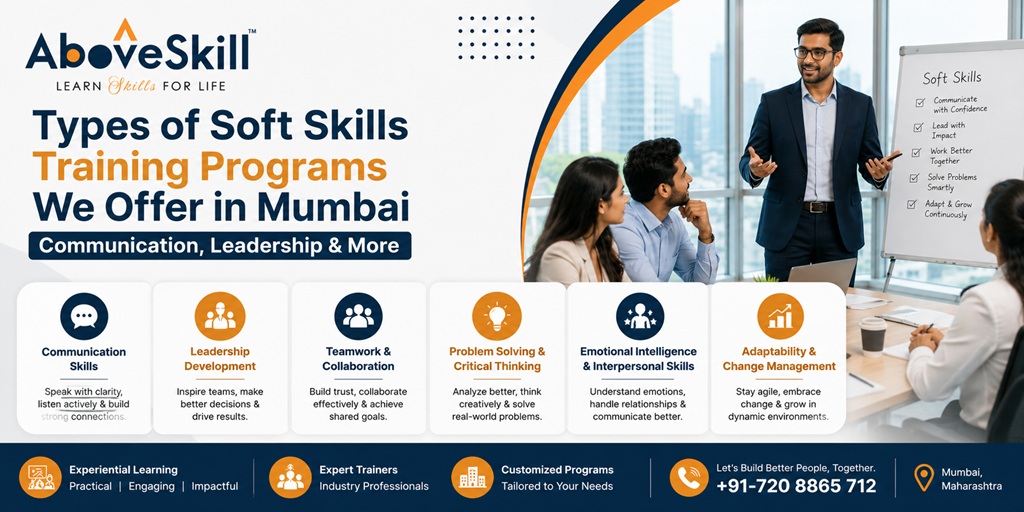
AboveSkill’s soft skills training programs in Mumbai cover fourteen core areas — communication, personality development, leadership, public speaking, presentation skills, interview skills, team building, emotional intelligence, time management, conflict management, negotiation, workplace etiquette, interpersonal skills, and critical thinking. Each is delivered as a standalone workshop or bundled into a longer program depending on what your team actually needs.
We get asked a version of the same question a lot: “what soft skills training do you actually offer?” Fair question — most training company websites list buzzwords without explaining what each program covers or who it’s for. Here’s the honest breakdown of Best Soft Skills Training in Mumbai programs we run, and how we decide which ones a team needs.
What Does Communication Skills Training Cover?
Corporate communication training covers verbal, written, and non-verbal communication — how clearly someone explains an idea, writes an email, or reads a room during a tense conversation. It’s usually the first program we recommend, because almost every other soft skill sits on top of it.
What Is Personality Development Training?
Personality development training focuses on self-awareness, confidence, and how someone presents themselves professionally — body language, tone, first impressions. It’s not about changing who someone is; it’s about removing the habits that get in the way of how their actual competence comes across.
What Does Leadership Training Involve?
Our leadership training programs build delegation, coaching, and accountability skills for people managing others — this is different from general communication training because it deals with authority, not just clarity. We design it separately for first-time managers versus senior leaders, since the challenges genuinely differ.
What’s Covered in Public Speaking Training?
Public speaking training addresses the mechanics of speaking to a group without freezing up — structuring a talk, managing nerves, using pauses and pacing deliberately instead of rushing through slides. Most participants come in worried about “sounding confident” and leave realising it’s mostly about preparation.
How Is Presentation Skills Training Different From Public Speaking?
Presentation skills training is narrower — it’s specifically about structuring and delivering a business presentation, including how you use slides, data, and visuals to support (not bury) your point. Public speaking is the broader skill; presentation skills is the applied, boardroom version of it.
What Happens in Interview Skills Training?
Interview skills training covers how to answer behavioural questions clearly, manage nerves, and communicate achievements without either underselling or overselling. We run this most often for campus hires and early-career employees preparing for internal promotions or external interviews.
What Does Team Building Training Actually Build?
Good team building training ties structured activities back to a specific collaboration or communication goal — it’s not the same as a fun offsite. We design each session around a debrief that connects the exercise to a real workplace situation the team actually deals with.
What Is Emotional Intelligence Training?
Emotional intelligence training builds self-awareness and empathy — recognising your own emotional triggers and reading other people’s, especially under pressure. The World Economic Forum’s Future of Jobs Report has repeatedly ranked emotional intelligence and self-awareness among the core skills employers say they need more of, and it’s one of the harder programs to fake — participants either engage honestly or the exercises fall flat.
How Does Time Management Training Help Employees?
Time management training covers prioritisation, realistic scheduling, and saying no to low-value requests — less about productivity hacks, more about decision-making under competing demands. It’s a popular add-on to leadership programs, since new managers often struggle here first.
What’s Included in Conflict Management Training?
Conflict management training teaches how to de-escalate a disagreement, separate the issue from the person, and have a hard conversation without it turning personal. We run this as scenario-based practice rather than theory, because conflict skills only really show up under real pressure.
What Does Negotiation Training Cover?
Negotiation training covers both formal negotiations (vendor contracts, salary discussions) and everyday workplace negotiation (getting buy-in, resolving competing priorities between teams). Most participants are surprised how much of it is about preparation and listening, not persuasion tactics.
What Is Workplace Etiquette Training?
Workplace etiquette training covers professional norms — meeting behaviour, email tone, how to disagree with a senior colleague respectfully. It sounds basic, but it’s often the fastest way to reduce the small frictions that quietly damage team relationships.
How Is Interpersonal Skills Training Different From Communication Training?
Interpersonal skills training focuses specifically on one-on-one dynamics — building rapport, trust, and working relationships — while communication training is broader and includes group and written communication too. In practice, we often combine the two for teams that are newly formed or going through a lot of change.
What Does Critical Thinking Training Include?
Critical thinking training builds structured problem-solving and decision-making skills — questioning assumptions, evaluating evidence, and avoiding snap judgments under pressure. It’s less commonly requested than communication or leadership training, but it’s increasingly asked for by teams making faster, more autonomous decisions.
How AboveSkill Structures a Soft Skills Training Program
- Needs assessment — a short call or survey with HR and team leads to identify the actual gap, not an assumed one.
- Program design — we pick from the fourteen areas above (often blending two or three) and build content around your industry and team level.
- Delivery — on-site, virtual, or hybrid, using role-plays, simulations, and real workplace scenarios rather than lecture-style sessions.
- Follow-up — a report and, where relevant, a short reinforcement session to check whether the behaviour actually stuck.
Comparing Program Formats
|
Format |
Typical Length |
Best Fit |
|
Single-topic workshop |
Half-day to 1 day |
One specific skill gap (e.g. presentation skills before a big pitch) |
|
Multi-topic bundle |
2–3 days |
Teams needing a foundational round of communication, EI, and teamwork together |
|
Cohort program |
4–8 weeks |
Leadership or manager-level development requiring practice over time |
|
Ongoing retainer |
Quarterly |
Organisations treating soft skills development as continuous, not a one-off |
Frequently Asked Questions
Which soft skill should a company train first — communication or leadership?
Communication almost always comes first, since leadership, negotiation, and conflict management all depend on it. Training leadership skills without a communication foundation tends to produce managers who know the theory but still struggle in the actual conversation.
Can these training programs be combined into one workshop?
Yes — communication, emotional intelligence, and team building are commonly bundled into a single multi-day program because they reinforce each other. We design the combination based on your team’s specific needs rather than offering a fixed package.
Is emotional intelligence training only for managers?
No, emotional intelligence training benefits employees at every level, though the scenarios and examples used differ for individual contributors versus people managers. It’s one of the few soft skills programs we rarely need to customise heavily by seniority.
How do you decide which soft skills program a team needs?
We start with a short needs assessment — usually a call with HR and a few team leads — to identify the specific friction point before recommending a program. Guessing based on job titles alone tends to miss the real issue.
Do you offer these programs for individual employees or only full teams?
Most of our programs are designed for intact teams or cohorts, since group dynamics are part of what we’re training, but individual coaching is available for specific roles like upcoming interviews or presentations. Ask us which format fits your situation.
What’s the difference between soft skills training and personality development?
Soft skills training covers a broad range of workplace competencies — communication, leadership, conflict management — while personality development is narrower, focused on confidence and self-presentation. Many programs touch on both, but they’re not interchangeable terms.
Which Program Does Your Team Actually Need?
If you’re not sure where to start, don’t guess based on a list like this one — tell us what’s actually going wrong in your team (missed deadlines, tense meetings, managers avoiding feedback conversations) and we’ll map it to the right program, or combination of programs, from what’s above.